
Born in İzmir, Turkey in 1974, the artist graduated from the Department of Graphic Design at Dokuz Eylül University Faculty of Fine Arts, later receiving training in Fashion and Accessory Design. During her education, she received awards in various design competitions. She graduated in 2000 with a thesis titled “Limited Imagination – The Designer’s Perspective.” In 2001, she founded Atölye Pi Design and Art Studio in Karşıyaka, İzmir. She held solo exhibitions both in Turkey and abroad, including “Düşbozumu,” “Yaz (-g-)ı,” “İnsan Kara Bir Leke Değildir,” “Oyunbozan,” “Tahteravelli,” “Bir Varlık Bir Yokluk,” and “Rüya Anıdan Sayılır mı?”. Her collection of essays titled “Diğer” was published by Alfa Publishing in 2024. She continues her work in writing, drawing, and sculpture at her studio in Karşıyaka, İzmir.
EXHIBITIONS
Exhibition Text: Melike Bayık
"Two Separate Bodies, A Pair of Voices"
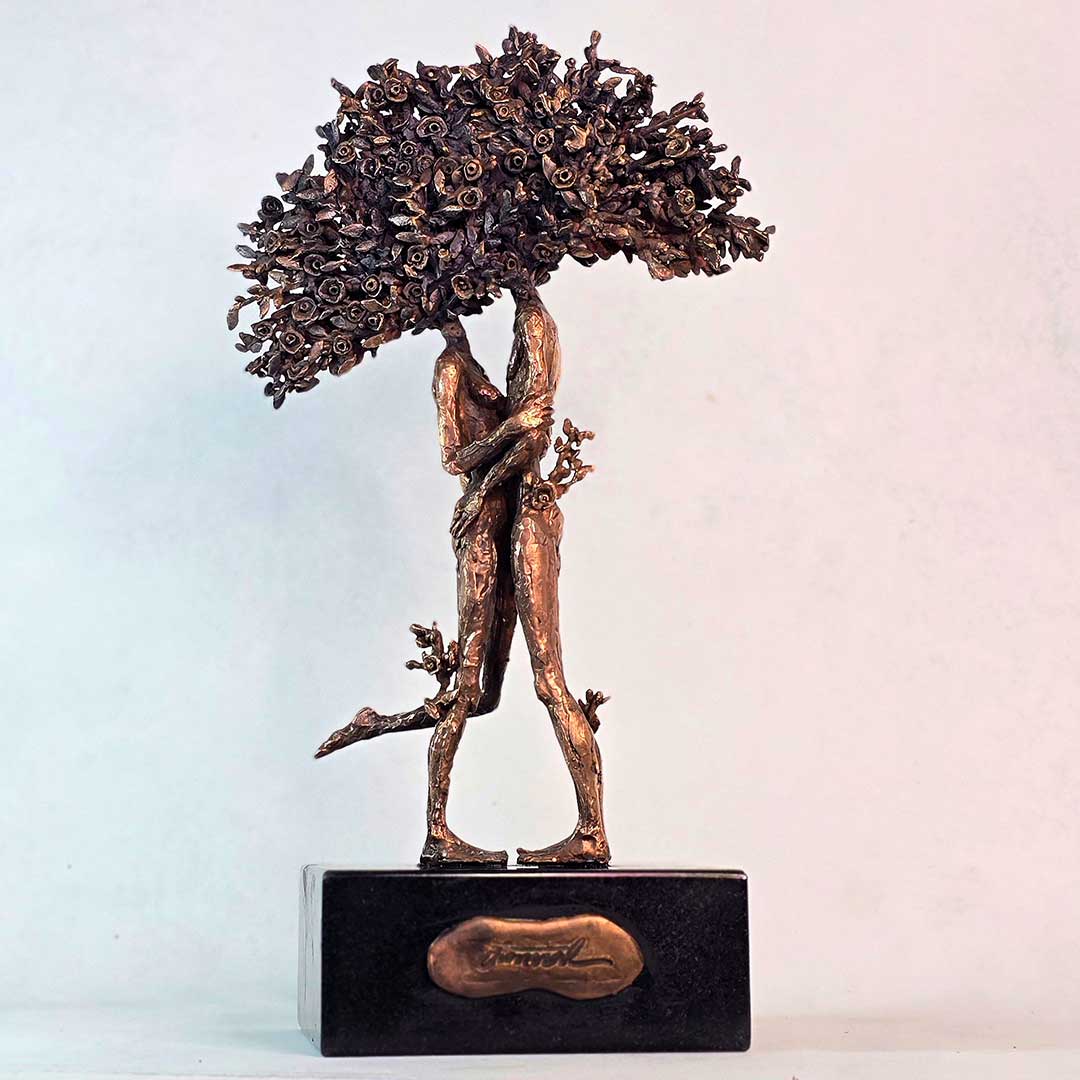
“A World for Two” begins as a possibility seeping through the edges of time, overflowing the boundaries of space. This world emerges not in the midst of a crowd but far from it; a form of retreat, a gesture of refuge against an age ruled by speed, harshness, and forgetting. Here, two figures are neither entirely facing each other nor entirely intertwined. They exist together without touching, side by side without merging. In this world, proximity matters more than contact, silence more than words, emptiness more than crowd.
Ozan Ünal’s bronze sculptures are not merely forms; they are spaces that one human opens to another. The nobility of bronze loosens the figures’ ties with time, placing them in an existential threshold beyond ages and places. This threshold has no language—but it carries a sensation. The sculptures do not speak, because silence itself is a mode of expression here. Echoing Michelangelo’s words, “The sculpture was already in the stone, I just removed the excess,” Ünal also removes the excess, defining even the emptiness between the two figures as a form.
This two-person universe is not just an aesthetic proposal. It also carries deep mythological and philosophical connotations. Duality is one of the oldest narrative forms in human history: the brotherhood of Castor and Pollux joined in the sky, the unseen love of Eros and Psyche, Orpheus’ final gaze at Eurydice… All these stories suggest that the invisible bond between two beings can be deeper than what is seen. Ünal’s figures summon this mythological memory—not merely a physical unity, but a spiritual solidarity.
The relational structure presented by the exhibition also echoes in the theoretical realm of contemporary art. One might refer here to Jean-Luc Nancy’s concept of “being singular plural,” where the subject is not conceived alone, but always with another. These sculptures propose a form of existence not born from completion, but from creating space for each other within emptiness.
This exhibition is also an act of resistance: a proposal to slow down in the age of speed, to remain silent in the age of noise, and to coexist in the age of domination. Perhaps the space between the figures is the fullest place of all. Because it holds mutual acceptance, recognition, and companionship. This two-person world carries the simplest, most fragile, most resilient, and most enduring form through which the self can open to the other.
And perhaps this world lasts only for a moment—a dream, a glance, a breath. Yet within that moment lies the most delicate home, the strongest bond, and the truest time that one person can offer another.
These sculptures are less of a narrative than a reminder: one does not diminish by being with another. On the contrary, one finds their place. For sometimes, the greatest worlds are built by just two people.