
Born in 1990 in Uşak, Talip Keser graduated from the Department of Painting at Muğla Sıtkı Koçman University Faculty of Fine Arts. With nearly twenty years of artistic practice, he gained an interdisciplinary perspective through the training he received in the early stages of his career in the workshops of Emin Özdemir and Orhun Kara. Since 2014, Keser has continued his production in his studio in Uşak, developing a unique language in contemporary art.
The artist's works have resonated widely on international platforms. In 2022, he participated in significant art events such as the Beijing Art Biennale (China), ArtShopping Fair Carrousel du Louvre (Paris, France), and Spectrum Art Fair (Miami, USA). In 2023, he showcased his works at prestigious organizations such as the UNFAIR Art Fair (Milan, Italy), Clio Art Fair (New York, USA), and The 100th Anniversary Art Exhibition GB Art Gallery (New Jersey, USA). His solo exhibition "Sürç-i Lisan" at GB Art Gallery in 2024 (New Jersey, USA) solidified his strong presence on the international art scene.
Exhibition Text: Melike Bayık
“A Walk Through the Rooms of the Heart”
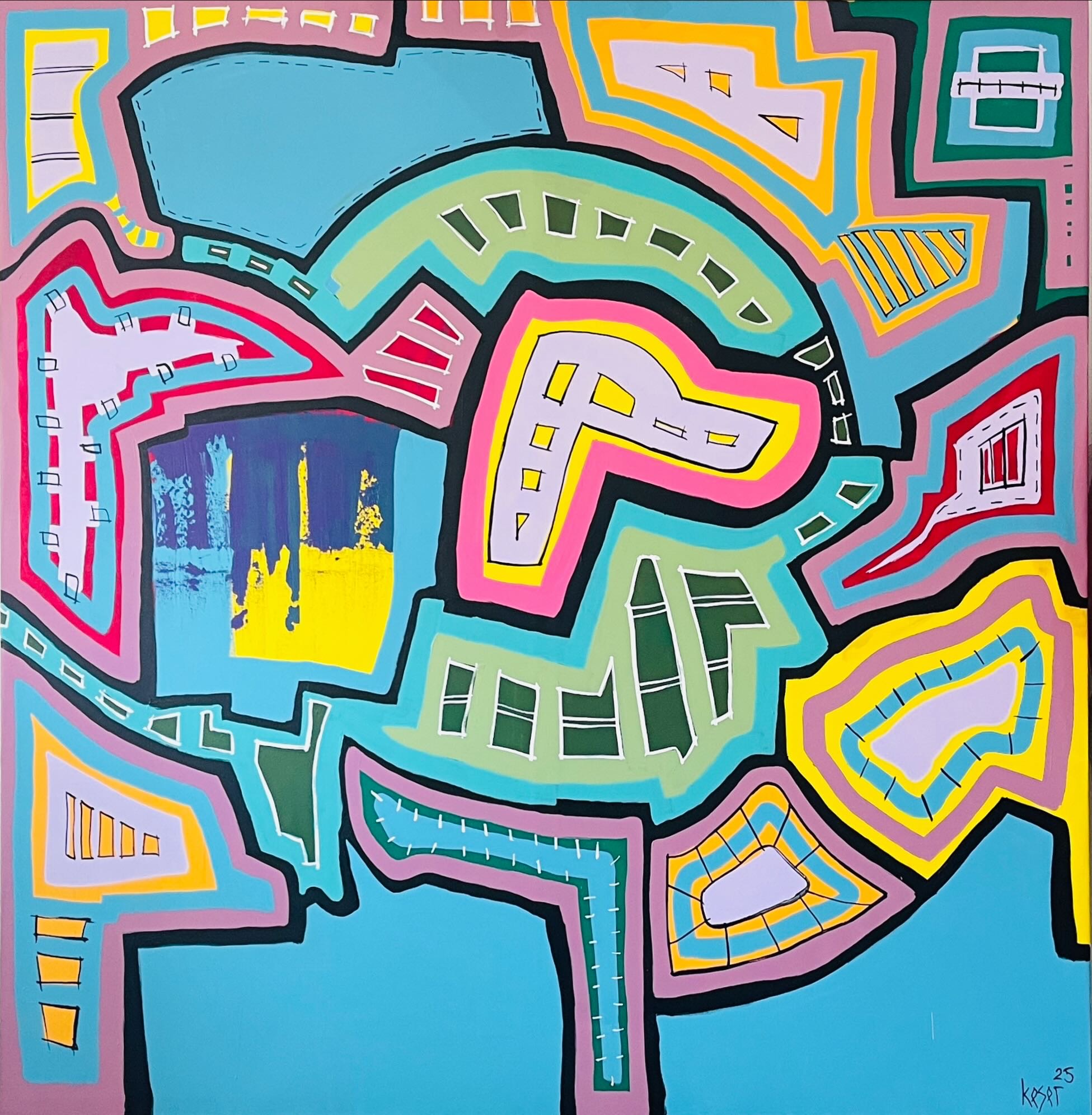
In Talip Keser’s exhibition titled “The Rooms of My Heart,” the canvases are not merely images presented for viewing, but abstract sketches of inner landscapes. In this exhibition, each painting suggests not just a room, but a direction, a compass, an inner orientation.
Keser’s approach represents a view that questions the formal boundaries of contemporary painting and centers subjectivity. Basic plastic elements such as color, line, and space transform into not only formal tools but also intuitive mapping instruments. Color represents the frequency of emotion; line suggests the direction of movement; space embodies the silent but profound echo of memory. Each composition is an abstract projection of a mental space—a visual notation of remembering, feeling, and rebuilding.
In this sense, Keser’s paintings can be read as a form of emotional cartography. Each stroke, each line on his canvases is a trace from childhood, a layer left behind by growing up, or a momentary deviation when imagination transforms into reality. Maps and city abstractions in this exhibition are not merely conceptual propositions but also formal tensions and narrative tools. The “rooms of my heart,” as Keser calls them, are actually border zones between consciousness and the unconscious. And each painting suggests not losing oneself at this border, but rather finding direction.
The artist’s quote “limitlessness starts within us” describes not only an individual search for freedom but also an aesthetic approach in which the visual language is deconstructed and its boundaries expanded. Here, there are no figures, but the absence of the figure is not a deficiency; it is the subjective anatomy of internalized spaces. Each work is like a topological deformation—an inner street, a map drawn, bent and reshaped according to the emotional twists of the individual.
In Keser’s compositions, lines carry a sense of direction rather than a fixed boundary. Colors represent not just a region but a representation. Spaces are left not discursively, but intuitively to be filled. In this sense, the viewer is not merely someone observing the surface of the painting but a traveler completing the missing parts of the map with their intuition. Each painting is an open-ended route. Perhaps not a space, but a mood.
As one approaches from the general to the specific, it can be said that this exhibition is not a self-portrait but an inner experience diary. Talip Keser speaks as much with what he hides as with what he shows. Each layer on his canvases is both the revelation of something and the concealment of another. This multi-layeredness transforms his paintings from mere aesthetic spaces into temporal, psychological, and almost architectural structures.
“The Rooms of My Heart” is a narrative where individual memory intersects with aesthetics, an inward-looking yet outward-reaching narrative. As Keser draws the sketches of his own rooms through his canvases, he invites the viewer to explore their own internal map, paths, and routes. Each painting is a direction; each direction, a new question... Perhaps the true exhibition begins right at the place where these questions echo and offers everyone a symbolic key to be discovered from one end of the map, to create a route.